I asked on Mastodon:
This year I discovered that second hand CDs are super cheap, and so have been buying old ones that I kind of 'missed' when I was younger.
I was chatting with a friend who's ended up doing something very similar with DVDs. He asked if I was trying to build a 'collection', like he at some point decided he should have all the Academy Best Picture films. I hadn't thought about it like this before.
There's nothing quite the same for music as the Academy Awards (for all their problems), but for those who consider themselves to have a music 'collection', is it purely things that you like or do you include albums that you think are essential in some way, even if it's not really your preference?
If you do, what are your top ten 'essential' albums?
Which resulted lots of really interesting posts of people's top ten 'essential' albums, but also a lot of questions around what 'essential' means: Are they your favourite albums - but is that favourites now, or those that made a big impact on you at the time, even if you don't listen to them much anymore? Or are these albums that are more representative of artists or styles you like? Perhaps something else again, more like the 'Best Picture' idea above - albums that generally considered excellent, and you think it's worth knowing, even if they don't mean so much to you?
For a lot of people their essential albums are the same as their favourite albums, and there a some great lists in the reply to my original question. Dom Tyer also suggested the great the 1001albumsgenerator.com site, as a source of widely accepted great albums.
Some people like Thomas ended up creating three lists for different interpretations, and Dan wrote three separate posts, one for each interpretation.
Ben interpreted this as being albums that were important and formative to him. Chris took a similar route, musing on albums that he likewise found formative, similar to Jake's earlier collection of 'Albums that Made Me'.
That's all great stuff (and you should read those lists, and more importantly their explanations of their choices), but having asked the question, I should also try and answer it for myself, but that means I have to decide what I think 'essential' means.
Finally, after too much umming and ahhing, I've decided that for me an 'essential' album is primarily one that meant a lot of me at the time and had a big impact in shaping my feelings, about life or music, and still means a lot. Music is a form of communication, and while the artists can have one intention behind a song, it's how the listener perceives it that really makes the connection, and gives it importance - but only for that person. Some albums were very important in a particular time or place, and may still be excellent, but perhaps not something I listen to at all anymore. For it to be 'essential' it's got to have stuck.
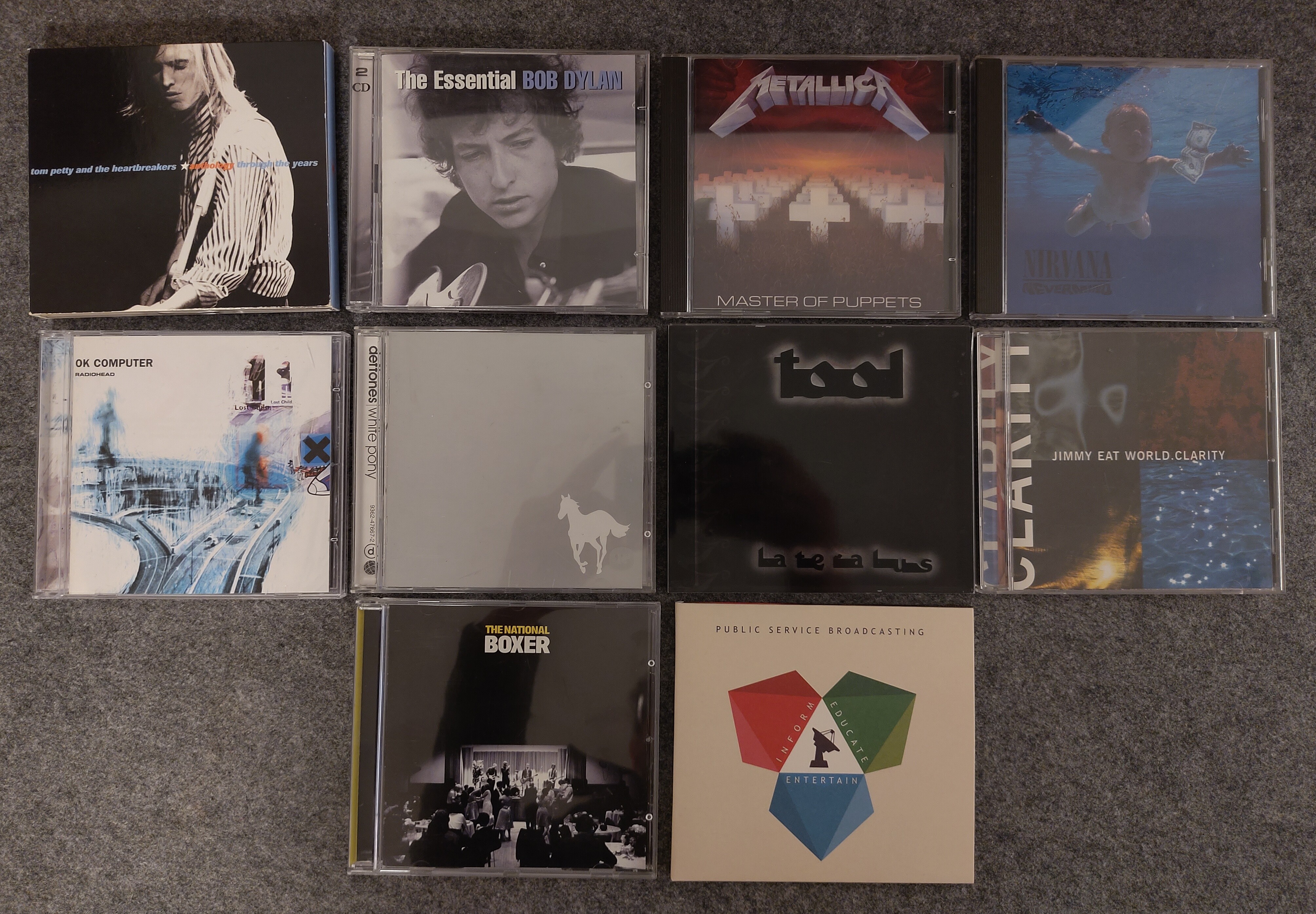
Anthology: Through The Years - Tom Petty and The Heartbreakers (2000)
Like Ben, compilations were an important part of my early listening. I think with streaming music they've largely been replaced by playlists, but back in 2000 if you'd just discovered a new artist, you wanted to learn more and they had an extensive back catalogue, then a 'best of' was the smart choice.
This 2 CD Anthology, along with the next one, I'd regularly play on a Sunday morning. All of these tracks are burnt into my memory. On the whole they're the more high energy tracks from across the Heartbreakers' albums, but it's a fine selection; all fine examples of Petty's ability to write a earnest and authentic rock song that seems so simple it should be shouldn't be possible.
The Essential Bob Dylan - Bob Dylan (2000)
I'd heard of Bob Dylan, and everyone spoke about him highly, and he was one of the Wilbury's I'd just learnt about, so again I turned to a compilation, The Essential Bob Dylan for more, and what I found was basically everything people had promised.
Even more than Petty, I think a compilation was the only way to get started with Bob Dylan in the 2000s. He's prolific, and has had such a long and varied career, that I can't think of one album that would serve as a good introduction. People love Blond on Blond, or Blood on the Tracks, but they're such a limited snapshot of his output. From the folk classics like The Times They Are-A-Changin', through the oddities of Rainy Day Women # 12 & 35, the haunting ambiguity of All Along The Watchtower or the righteous anger of Hurricane.
Perhaps the one thing a compilation does lack, by its nature, is a sense of time and place. I like all the songs on these compilations, and they were incredibly formative in my feelings on what makes a good song, lyricism and how to tell a story in three minutes; and individual songs have meant different things to me at different times, but as a whole they're floating and timeless. When I listen now to that track listing, mostly what I get is nostalgia for when I was first listening to it.
If I wanted to listen to Dylan now, I'd probably play Bringing It All Back Home or for Petty Damn The Torpedoes, and not one of these, but in setting my early musical taste, they are certainly essential.
Clarity - Jimmy Eat World (1999)
Clarity was not the first Jimmy Eat World album I bought, that was Bleed American1, which is also a truly excellent album. In making this list I've limited myself to one album per artist, but if I allowed myself more, this would be the one. Bleed American is amazing, it has the energy and riffs of a good punk album, but with more satisfying emotional and introspective lyrics - the definition of much derided genre emo, even if I feel Jimmy never to have been mopey, and varied, like later tracks Cautioners and Hear You Me. But I'm not meant to talking about this amazing album, but the one before.
So why am I picking Clarity then? There's two parts - the first is that it is, especially in the approximate genre of emo/hardcore/punk, unique. It starts with a humming organ, but not as a fleeting intro to be replaced by three power chords, but as an integral part of the song. There's violins, drum machines, Glockenspiel and cello; but never as a novelty or a distraction, but as carefully chosen ingredients. It still has more typical 'emo' tracks like Blister, Your New Aesthetic or Crush. But then there's the crossovers like the soaring Ten, rising and falling with the protagonists' uncertainty, followed by Just Watch the Fireworks and For Me This is Heaven both of which always bring tears to me eyes - this isn't an album I can just casually listen to. I need recovery time. And the sixteen minute(!) Goodbye Sky Harbour with its drifting variations as the last track is perfectly placed to try and set you up for re-entry into reality.
Like its patchwork cover art, all disparate patterns and materials, how did this strange hybrid come to be? That's the second reason I love this album. After their disastrous experience on Capitol Records with their previous album Static Prevails, the record label just ignored them, but let them record a third album, leaving them to their own devices. As the Dan Ozzy book Sellout describes, convinced this would be the last time they'd ever get the chance of recording an album, and no-one from the label caring, they swung for the fences and tried whatever they could. I think that's the other factor that makes this record amazing; that strange combination of knowing it's your last chance, so you have to use it, but also that there's zero expectation to write songs that will sell - so you might as well try whatever you want, the only people you're trying to make happy is yourself; and the results are amazing. I sometimes try to take that as some kind of moral: don't focus on what others want from you, but focus on what satisfies you, and the results will be much better.
Master of Puppets - Metallica (1986)
This is my definition of metal music. A friend in school lent me the album not long after I got a CD player, and the album absolutely floored me. The speed, the precision, the power, the melodies and how heavy it was. I hadn't really heard anything heavier than AC/DC, Guns'n'Roses or The Offspring before, so this was huge contrast. I had to listen to it at least three times just to get used to the sound before I could really comprehend what was happening.
It's still my favourite Metallica album. It is also the benchmark to which I compare anything else that could be considered metal to this day. It was also a while before I heard much other metal. Bands like Pantera, Megadeth, Slayer came a bit later, but after Metallica had already embedded themselves into my mind as THE definition of metal, and in some ways I still struggle to get away from that for anything that's not the 'fast and loud guitar' style of metal.
Nevermind - Nirvana (1991)
This is such a classic it almost feels unnecessary to explain its inclusion. I didn't really start paying attention to music until the mid-Nineties, so missed the height of Grunge, and by the time I started listening to the radio on a regular basis Britpop was in the ascendancy.
I first heard Nevermind from a friend's tape Walkmen while sitting in the darkness of a coach that was taking us overnight to Brittany for our school's French Exchange. The sound quality through one cheap earbud on a rattling coach was awful - but the melodies and riffs are so distinct that you can still pick them out. At first I didn't really understand most of the sarcastic lyrics, and those of Cobain's struggling with his own fame, like In Bloom, but being a melodramatic teenager meant I could relate to the feelings of insecurity, resentment and frustration that are more obvious in the album. As such it was one of the first albums I experienced that felt like it was talking to me and I could relate to, but unlike other more punk albums I can think, Nevermind has managed to stay more relevant.
Lateralus - Tool (1991)
Tool were recommended to me by a friend who played drums and I would occasionally jam with, which is understandable given Tool's drummer Danny Carey's highly technical drumming skills.
At first I didn't really know what to make of it, it was metal, I guess? But the songs were either strange little interludes, or seven to eleven minute epics of strange churning rhythms, a bass that lead the melodies, and a guitar that was either just chugging sounds or strange screeches.
It didn't seem to make much sense, until suddenly it did. It was like learning to see in the dark, what had been vague shapes hidden in shadow before suddenly became clear, the instrument's roles suddenly made sense in this new World. Once you accepted that the drums and the rhythm were the song, not just the supporting structure, you don't need a guitar for melodies, a bass shouldn't be limited to just anchoring the chord progressions. Plus the voice - Maynard's whispering, calling, screaming above and through all these twisting different strands of rhythm, it was just something so alien, but once it'd clicked for me, so astounding.
Previously to Lateralus I had listened to albums that rewarded repeated listening. You'd hear new lyrics, pick up on additional melodies, or details you didn't hear the first few times. The songs would become richer as you picked up on their details and subtleties. Lateralus was much more dramatic; yes and the second or third listen you'd hear more details, but that didn't reveal the whole. Then suddenly, like the black silhouette of a candlestick on a white background, it's not a candlestick anymore, but it's two faces.
Since I've never experienced any other album to have had such a dramatic a shift in perception, there have been a few that have had something similar, where it takes a while to click with the 'concept' of the album, and understand what the artists was trying to do, but it's never been as world upending as Lateralus.
(Also the CD album art is excellent, it's a transparent plastic booklet with a different layers of a figure that are revealed as each page lifts up.)
OK Computer - Radiohead (1997)
One Friday there was a 'block party' in my first year of university in the halls of residence. These halls where split into little 'flats', each with 5-7 rooms that shared a bathroom and kitchen, with these flats built into blocks of six that shared a stairwell. Music was playing in the various kitchens, where people would park their self brought drinks, then chat, dance or eat badly heated cheap frozen pizza. As the night wore on people would tend to split off into smaller groups in the various rooms in the flats. In this case I ended up, in the wee hours, in a room of people discussing music, in that earnest, self important and absolute way that only eighteen year-olds have.
It was 2002, so of course I'd heard of Radiohead, I even had a copy of Lucky on my Now That's What I Call Music 32 double cassette compilation; I wasn't a complete philistine. To me Radiohead the had a reputation of being for depressing whingey songs, with the occasional good rock one, liked only by music snobs to be contrarian. Case in point was a friend from school who was a big Radiohead fan, and was very much a contrarian music snob.
And that's the debate happening at 3am in this room, between random students I didn't know, lounging around a dimly lit room. By this point Radiohead had long grown out of their starting grunge/rock sound with OK Computer (1997), Kid A (2000) and Amnesiac (2001). There were arguments about how they were better originally, and now they were only making music to try and impress the NME, who in turn only liked them to pretend to be sophisticated while trying to sell everyone the idea that The Vines and The Strokes were going to save rock'n'roll - which they clearly weren't.
One lass then went to bat for Radiohead, laying out the argument, that if you didn't 'get' Radiohead anymore, it's because you hadn't paid attention to OK Computer. It was the perfect album, and the bridge between what you'd like before and what they were doing now, and it made it make sense. It had the strange experimental instrumentation, but the structures were more accessible. You have the drifting Exit Music (For A Film), but you also had the relatively straight up Karma Police. Electioneering is a raucous stagger that seems all drums and squealing guitar, but there's still a rock song in there. Climbing Up The Walls is a spaced out and disorientating echoey lullaby that turns into a fuzzy cloud - but the following No Surprises will put you back onto familiar ground.
It perhaps required more work than previous albums, went her argument, but it was worth it, and if you really liked music, like everyone in the argument claimed they did, surely you were willing to put in the little bit of work it required to access this music goldmine?
The next weekend I bought OK Computer, and it turns out she was right. I don't think I ever saw her, or anyone else in that room, ever again - so thank you random music nerd girl2.
White Pony - Deftones (2000)
Like Lateralis, White Pony is probably metal because it's not anything else - but it's not metal in the traditional sense, it's more like the haunting ghost of metal. The riffs are there, but often huge and sweeping somewhere in the distance like a storm over the horizon. Deftones got lumped into the Nu-Metal because they were emerging around the same time, and were adding no-typical metal instrumentation in, along with hip-hop elements, especially in the drumming - but I'm not sure that's really something that connects them with other bands in that group, and I feel they've always been very much their own thing, not really sitting in any sub-genre of metal.
It's also an album that invokes in me a very particular feeling, some kind of strange tired, early morning haze, and seems to transport me to this state of mind every time I listen to it. I don't think I ever listen to any of the songs on their own, they don't make sense to me out of context.
That's also what makes it special, and why I consider it 'essential'. I love lots of the Deftones' other albums, and they contain many of the details that are present on White Pony - Chino Moreno's whispered, distorted and strangely illicit sounding vocals, the characteristic riffs and droning strings of Carpenter's "strings"3, and the 'pop' of Abe Cunningham's snare in his unique drum patterns. But they don't create this same atmosphere, and transport into this strange dream world, like White Pony does.
Boxer - The National (2007)
2008 was a strange year as I was ill or injured with various ailments for large parts of it. I'd returned to Bristol to start working more steadily at one job, and started my longest and most series romantic relationship4.
One morning while recovering in bed the radio played Fake Empire, and the little off kilter piano riff instantly pulled me in, and the lyrics seemed to be saying something I hadn't been able to express:
Turn the light out, say goodnight
No thinking for a little while
Let's not try to figure out everything at once
It's hard to keep track of you falling through the skyWe're half awake in a fake empire
We're half awake in a fake empire
The year felt like a strange mix of things that could be important life events, or things that might just fade into other memories, and there was no way of telling at this point which they might be. That inability to discern the two, and act on them in any way that would guarantee a particular result felt like exactly what "We're half awake in a fake empire" meant. You like to think you're in control, but there's too much random chance to really claim that you're in charge.
The rest of the album also matched this feeling, combining a World-weariness, and just accepting what's happening, to you, with the worrying uncertainty that perhaps you really can do something about it, and so any unhappiness is actually your fault.
Tracks like Slow Show capture the awkwardness and self consciousness of trying to impress someone while over thinking everything, and Apartment Story is both a sweet and terrifying description of spending time with someone without any specific plans, and just being in each other's company. Mistaken for Strangers also delves into the contradictions in how you present yourself, and who you are, and if you're changing that for another person, how obvious is it?
Also the drumming is low-key amazing. It doesn't stand out at first, just perfectly fitting in everywhere, but once you pick up on it, the fills, and flourishes, just seem so perfect, without ever being over the top.
Inform - Educate - Entertain - Public Service Broadcasting (2013)
I generally don't go to festivals, me and camping have never got along. In 2013 some friends suggested we go to the inaugural ArcTanGent Festival, which is held very close to where we lived, Bristol. Even better, one of the friends doesn't drink, and would be driving there and back each day, so I could sleep in a bed that fits me each night.
On the first evening we ended up staying in the Bixler stage, after watching That F-cking Tank, and were intrigued to see a band setting up, where one was in a tweed suit, the rest with shirts and ties, assembling what looked like NASA mission control in a tent, flanked either side by towers of old TVs playing old documentary film clips. This was Public Service Broadcasting (PBS).
Compared to other acts at ArcTanGent, their set wasn't super high energy - which is understandable when band frontman J. Willgoose Esq. is somehow playing guitar, keyboards, samples, and banjo in his control centre, all seemingly at the same time - but it was captivating.
The music was fascinating and something else, all the songs were based around documentary film audio, and the song taking up the story of the film. I'd heard countless song with samples before, mostly tightly looped, but PBS are seemingly unique in that they normally don't use the samples to create the music itself, but build the songs, which they play, around them.
Everest is my favourite track, which can send shivers down your spine, as you imagine the tiny figures up on the mountain "Cutting steps in the roof of the World". Night Mail is another brilliant song, with the lyrics mostly the poem of the same name by W. H. Auden, who wrote it for original film.
Apart from the actual songs, and the originality (at least to me) of their creation as collages cut from another medium, is that it was probably the last major album discovery for me before leaving Bristol. Later in 2013 I moved jobs and countries, and it marked the end of a more free-wheeling time, and a regularly seeing a specific group of friends whom I'd spent the last seven years with. While with time people were already moving away and that social circle was starting to dissolve, this move created a hard 'end' for me.
That makes the montage approach of old documentary footage somehow seem appropriate, as I spent the rare free moment in those hectic last months reflecting back to the times, people and experiences I'd collected in the last few years. These reflections, being re-interpreted through the knowledge that this time was coming to an end, and somewhat re-mixed into a new perspective with new meaning.
Beyond the Ten
Picking exactly ten albums is very arbitrary, and while the first few were easy to pick, as the list went on it became harder and harder. It seems unfair to leave other albums that I consider 'almost essential' out, as there's so little difference between them and the ones that just made the cut-off. But this post has already been a jumbo entry5 in my loose My Classic Albums series, so a brief mention will have to do for now, until they perhaps get their own post.
Searching for a Former Clarity (2005) by Against Me! was just outside the cut off, but that already has its own post, so you can read that if you've somehow not had enough already. In a similar vain of punk rock about growing up and living with your choices, On the Impossible Past (2012) by The Menzingers also had a big impact on me. I should probably also mention The Color and The Shape (1997) by the Foo Fighters, which was early purchase frequent play, plus I still think Everlong is my favourite song of all time.
I noticed that my essentials are very US-centric, and there's little BritPop influence, which is perhaps strange given BritPop's peak during my early teenage years, but for whatever reason none of the bands most associated with that grouping spoke to me. One UK band that I've long loved are Idlewild, and I do consider 100 Broken Windows (2000) their greatest work, and it's a great indie rock/emo/punk album of trying to work out just how seriously to take yourself. In that vain I do think that Bleed American (2001) should also be on the list, while it's a second album by Jimmy Eat World, it's also one of the reasons they're my favourite band.
I'm also a big fan of instrumental/post-rock music, which hasn't featured in my list so far. While not totally instrumental I think Isis' Panopticon (2004) is responsible for taking me in that direction, and Caspian's Hymn For The Greatest Generation (2013) EP is one I love, not just for the titular track, but also the demo version of High Lonesome that's included and somehow seems even more delicate and touching that the album version.
She also was trying to tie OK Computer into her version of the 'The third album is always the best' grand unified theory of music criticism that allows you to predict the future output of bands reliably, a theory I'm not so onboard with. Having said that, if you're counting 'studio albums', then I think this list of 8 none-compilations contains five 3rd albums, namely Master of Puppets, Clarity, Lateralus, OK Computer and White Pony. So perhaps she's right about that too. ↩
In the liner notes Carpenter is credited with 'strings', not guitar (unlike Moreno who's given Voice/Guitar credits), which seems like proof that they were approaching this differently. For reference; Around the Fur credits Carpenter as guitars, as does the later Koi No Yokan. On Deftones and Saturday Night Wrist I couldn't see credits that linked a band member to any specific contribution. ↩